


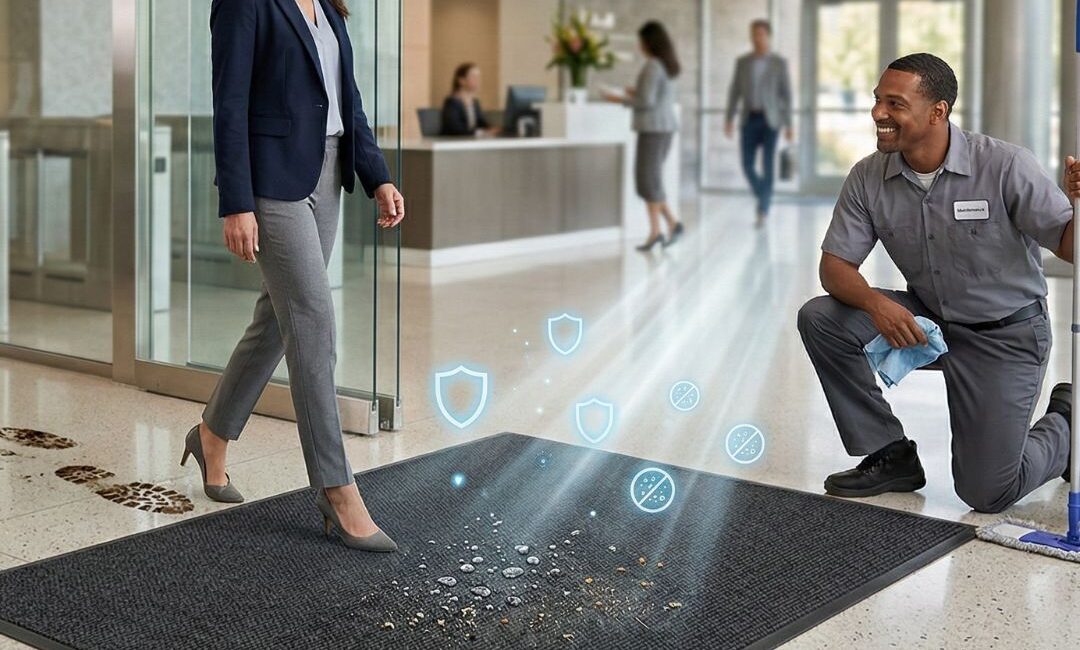
Most facility managers choose floor mats for appearances or slip prevention. What they do not realize is that commercial floor mats are one of the most powerful health protection tools in any building , quietly working every single day to keep employees, customers, and visitors safe.
At Universal Floor Mats we have spent over 20 years supplying entrance mat systems to government facilities, commercial buildings, healthcare centers, and retail environments across the United States. Here is what the science — and our experience — tells us about the real health impact of quality commercial matting.
1. Commercial Floor Mats Stop Up to 80% of Contaminants at the Door
The single most important health function of any entrance mat is keeping outside contaminants outside.
Research consistently shows that up to 80% of all indoor contaminants enter a building through foot traffic. Dirt, pollen, bacteria, pesticides, road chemicals, and allergens cling to shoe soles and travel directly into your facility with every step.
A properly sized, high-performance entrance mat system captures these particles before they can spread through your building. The result is measurably cleaner air, reduced cleaning costs, and a significantly healthier indoor environment for everyone inside.
The key is coverage. Industry standards recommend a minimum of 10 to 15 feet of matting at every entrance to allow enough steps for contaminants to be fully captured before a visitor enters the main floor area.
2. Floor Mats Dramatically Improve Indoor Air Quality
Every particle that gets trapped in the fibers of a commercial floor mat is one less particle circulating in your indoor air.
This matters more than most people realize. Studies show that indoor air quality can be significantly worse than outdoor air — particularly in high traffic commercial environments. Dust, pollen, mold spores, and fine particulates that enter on shoes quickly become airborne when disturbed by foot traffic or HVAC systems.
Quality entrance matting reduces:
- Airborne dust and allergens
- Pollen and seasonal contaminants
- Fine particulates from outdoor pollution
- Frequency of deep cleaning required
For facilities serving vulnerable populations — healthcare centers, schools, assisted living facilities, government buildings — the air quality impact of proper matting is especially significant.
3. Moisture Control Prevents Mold, Mildew, and Slip Hazards
Wet entrances are dangerous on two levels — they create immediate slip and fall hazards, and they introduce moisture that can lead to long-term mold and mildew growth.
Commercial entrance mats with high absorbency ratings:
- Capture water and snow before it spreads across hard floors
- Reduce slip and fall liability — the leading cause of general liability claims in commercial buildings
- Prevent moisture from penetrating flooring substrates where mold can develop
- Protect expensive hardwood, tile, and carpet from water damage
For facilities in the Mid-Atlantic region — Maryland, DC, Virginia — where seasonal rain, snow, and humidity are consistent concerns, moisture-controlling entrance matting is not optional. It is essential.
4. Anti-Fatigue Matting Protects Employee Health and Productivity
For employees who stand for extended periods — retail associates, healthcare workers, warehouse staff, kitchen personnel — the surface they stand on directly impacts their physical health and workplace performance.
Anti-fatigue mats are clinically shown to:
- Reduce lower back pain and leg muscle fatigue
- Improve circulation in employees standing for prolonged periods
- Decrease the risk of musculoskeletal disorders
- Reduce absenteeism related to workplace discomfort
OSHA guidelines recognize prolonged standing on hard surfaces as an ergonomic risk factor. Anti-fatigue matting is one of the most cost-effective workplace health interventions available — far less expensive than workers compensation claims or lost productivity from discomfort.
5. Floor Mats Capture Chemical Toxins and Pesticides
Modern outdoor environments expose shoe soles to a complex mixture of chemicals — pesticides from lawns and landscaping, heavy metals from road surfaces, fuel residues from parking lots, and industrial pollutants.
Many of these chemicals are invisible and odorless. Without effective entrance matting they travel directly into your facility and settle on floors where they can be re-aerosolized by foot traffic.
This is particularly critical for:
- Facilities serving children — who play on floors and have more direct contact with floor surfaces
- Healthcare environments — where chemical contamination of sterile areas is a serious concern
- Office environments — where employees spend 8 or more hours daily in direct proximity to floor surfaces
- Pet-friendly facilities — where animals have constant floor contact
High-performance commercial mats with dense fiber construction are most effective at trapping and retaining chemical particles.
6. Antimicrobial Matting Reduces Pathogen Transmission
Advanced commercial floor mats are available with built-in antimicrobial treatment — a critical feature for healthcare facilities, food service environments, and any high-traffic public building.
Antimicrobial mats:
- Suppress bacterial growth within the mat fibers
- Reduce pathogen transmission via footwear
- Control odors caused by microbial activity
- Maintain effectiveness through repeated cleaning cycles
In a post-pandemic commercial environment where clients and tenants expect demonstrably high hygiene standards, antimicrobial entrance matting is increasingly a specification requirement rather than an optional upgrade.
7. Clean Environments Support Mental Health and Workplace Wellbeing
The connection between physical environment and mental health is well documented. Cleaner, better-maintained spaces are directly associated with reduced stress, improved mood, and higher productivity.
The indirect mental health benefits of quality commercial matting include:
- Cleaner, more professional-looking environments that reduce stress for occupants
- Reduced physical discomfort from anti-fatigue matting that lowers stress responses
- Fewer slip and fall incidents that cause anxiety for both victims and witnesses
- Lower maintenance burden on facility staff reducing workplace stress
When visitors step through your entrance onto a clean, well-maintained mat system they immediately perceive your facility as professional, cared for, and safe. That first impression affects how they feel about their entire experience in your building.
How to Maximize the Health Benefits of Your Mat System
Choosing the right mat is only the first step. To maintain peak performance:
Clean regularly. High-traffic mats should be vacuumed daily and deep-cleaned weekly. Dirty mats lose their ability to capture contaminants and can themselves become a source of indoor pollution.
Size correctly. Undersized mats are one of the most common and costly mistakes in commercial matting. Cover the full entrance width and provide enough length for multiple steps.
Replace on schedule. Even premium commercial mats have a service life. Worn, compressed, or damaged mats lose their effectiveness and should be replaced proactively.
Use a layered system. The most effective entrance systems use a three-mat approach — a heavy scraper mat outside, a wiper-scraper mat at the entrance, and a wiper mat inside. This progressive system captures contaminants in stages for maximum effectiveness.
Protect Your Building and the People Inside It
Universal Floor Mats has provided custom entrance mat solutions to government agencies, healthcare facilities, commercial buildings, and retail environments across the United States for over 20 years.
Whether you need a single custom logo mat for your lobby or a comprehensive entrance system for a multi-location facility, our team of specialists is ready to help you find the right solution.
Ready to upgrade your entrance matting system? Request a Free Quote or call us toll free at 1-888-605-0678. Our mat specialists are available to assess your facility and recommend the right products for your specific health and safety requirements.